
Home/Study Guides/Air Quality & Pollution Control
Air quality and pollution control, all of Section 4.
Covers both subsections of Section 4: engineering applications and pollution control. Section 4 carries 13 to 20 of the 80 questions, tied with Site Assessment as the second-largest section. Written for the Principles and Practice of Engineering (PE) Environmental exam from the National Council of Examiners for Engineering and Surveying (NCEES), to the April 2026 specification.
A comprehensive prep course runs $1,600 to $2,800. All six guides are $129 as a set.
77 pages · 22 worked examples · 7 Field Notes · prints cleanly
What the guide covers.
Only the most-tested material makes the cut. Derivations, untested background theory, and very low-frequency topics are omitted to keep your study time focused on what matters the most.
- Atmospheric science. lapse rates, stability, and the Pasquill-Gifford classes
- Gaussian plume dispersion. the plume equation, ground-level centerline concentration, effective stack height and plume rise, reading the dispersion coefficients, and ppm to micrograms per cubic meter
- Combustion and emissions. stoichiometry, air-fuel ratio and excess air, stack gas corrections for moisture, temperature, pressure, and reference oxygen, and emission factors
- Particulate control. size-distribution efficiency, cyclones, baghouses, and electrostatic precipitators (ESPs)
- Gas and vapor control. Henry's and Raoult's laws, venturi scrubbers, thermal and catalytic oxidation, carbon adsorption, and condensation
- Nitrogen oxide control. how it forms, combustion modifications, and post-combustion controls
- Standards and monitoring. criteria pollutants and the National Ambient Air Quality Standards, the Air Quality Index, ambient monitoring, EPA reference methods, isokinetic sampling, opacity, and continuous emissions monitoring
- Regulatory quick reference. Clean Air Act structure, attainment and state implementation plans, New Source Review, control technology standards, operating permits, and hazardous air pollutant rules
Every topic, built the same way.
A consistent layout means you always know where to look, the same way you will move through the handbook on exam day.
01 · Concept
The key idea
What the exam is testing on the topic, stated plainly.
02 · Formula
Equations with units
Every variable defined, with the handbook page where the formula appears, or a note that you have to memorize it.
03 · Example
Worked in exam style
A full worked example in the multiple-choice format the exam uses, with the arithmetic shown.
04 · Mistakes
Where points are lost
The errors that cost candidates points on that topic, named so you can catch them.
Summary sections you will want to use
- Exam strategy for the section. Question count and weight, the calculation-versus-conceptual split, common traps, and what the handbook gives you.
- Regulatory and qualitative quick reference. The rules, limits, and distinctions the section tests, in tables, to support success on the qualitative questions.
- Key formulas summary. Every equation in the guide, grouped by topic, with unit conversions.
- Self-assessment checklist. Check off each subtopic as you master it.
Seven Field Notes from practice.
Short sidebars with the operating context textbooks leave out. They are what make the processes and the regulations stick.
Cover more of the exam for less.
The whole exam · Complete Guide Set
All six guides for $129
One guide for every section of the specification. 348 pages and 118 worked examples, $174 if bought separately.
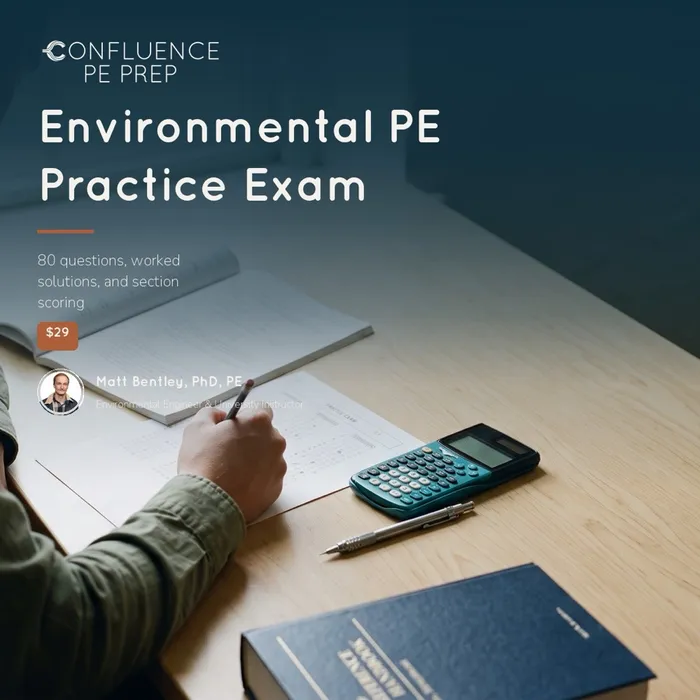
Not sure this is your weak area? · Practice Exam
Rank all seven reporting areas first
80 questions built to the 2026 specification, a separate solutions manual, and a score sheet that points each weak area at the guide that closes it.

Matt Bentley, PhD, PE
Environmental engineer, university instructor, and Technical Director at a water treatment chemical company in Colorado. Passed the Environmental PE in February 2026, on the first try, in under 80 hours. He wrote this guide from the materials he wished had existed when he was preparing.
Section 4 is 13 to 20 of the 80 questions. Walk in ready for it.
77 pages · 22 worked examples · or get all six guides for $129
Common questions
What does this guide cover?
This guide covers all of Section 4 in the April 2026 NCEES specification (4A and 4B): atmospheric stability and Gaussian plume dispersion, combustion and stack gas corrections, emission factors, particulate and gas control devices, volatile organic compound and nitrogen oxide control, the National Ambient Air Quality Standards, monitoring and stack testing, emissions inventories, and the Clean Air Act permitting framework.
How many Environmental PE exam questions does this guide cover?
Section 4, Air, carries 13 to 20 of the 80 questions. This guide covers both of its subsections, 4A and 4B.
Is it written to the April 2026 NCEES specification?
Yes. It was written to the April 2026 computer-based testing (CBT) specification from the first draft and covers Sections 4A and 4B. See what changed in 2026.
Does it reference the NCEES PE Environmental Reference Handbook?
Yes. Each formula cites the handbook page where it appears, and formulas the handbook does not print are marked as ones to memorize. The guide opens with a section on what the handbook gives you for this part of the exam.
What do I get, and how fast?
A 77-page PDF, downloaded immediately after checkout through Gumroad. It has 22 worked examples, 7 Field Notes, and 3 technical figures, and it prints cleanly.
Can I buy it with the other guides?
Yes. The Complete Guide Set includes all six guides, one for every exam section, for $129 instead of $174.
Can I get a refund?
Because the products are digital downloads delivered immediately, sales are generally final. If something is wrong with a purchase, email matt@confluencepeprep.com and we will work with you to resolve it.