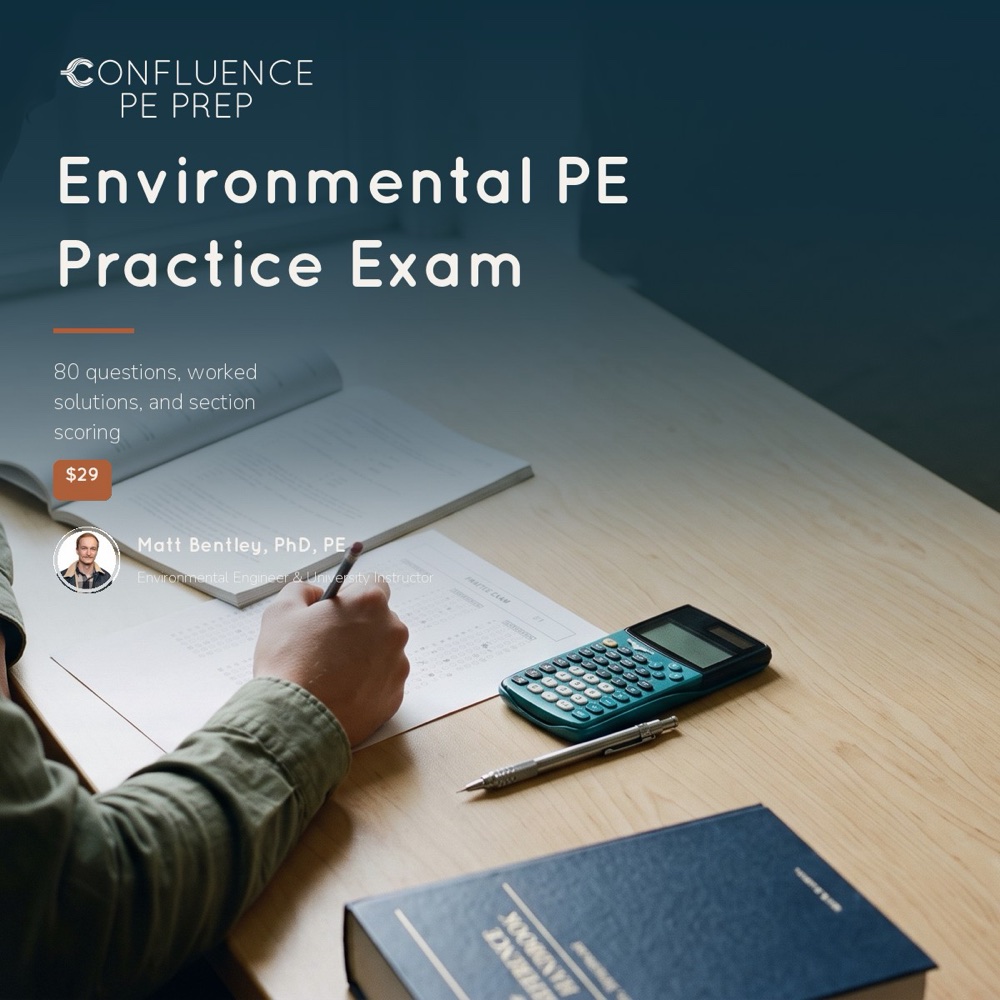
Six focused study guides and a full-length diagnostic exam, written by a practicing environmental engineer who passed on the first try in under 80 hours. Find your weak areas first, then study only those.
Want to know where you stand first? Take the practice exam · $29
Most PE prep courses cost $1,600 to $2,800 and cover everything, whether you need it or not. Study what you need. Skip what you don't.
Formulas, worked examples, and regulatory tables. No filler, no generic test-taking advice you've already heard.
Structured for 60–90 days of targeted prep you can do while holding down a full-time job.
Written to the April 2026 spec from the first draft, including the new Sustainability section.
Section priorities by exam weight and a realistic week-by-week schedule. The approach behind a first-try pass in under 80 hours.
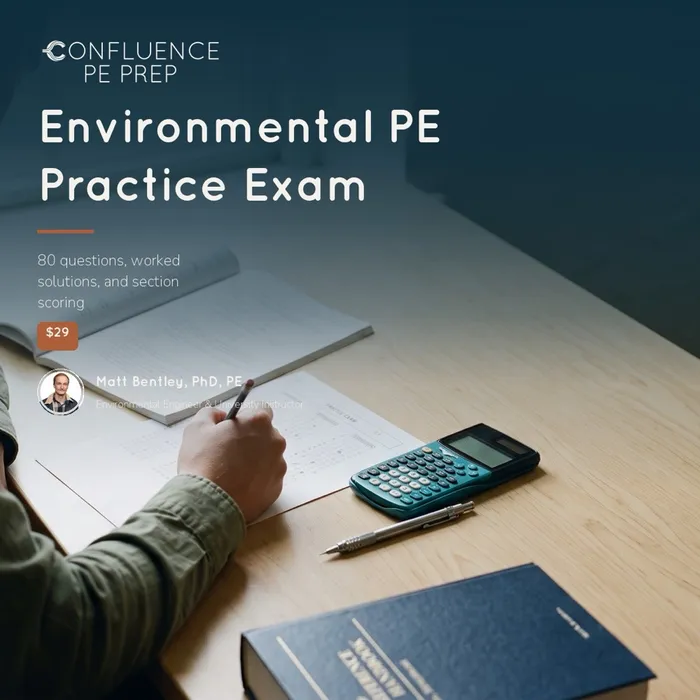
Send me the plan → Step 2 Diagnose · $2980 questions at the section weights set by the National Council of Examiners for Engineering and Surveying (NCEES), and a score sheet that ranks your seven reporting areas, weakest to strongest.
See the practice exam → Step 3 Close the gaps · $29 eachOne guide per exam section: formulas with units, NCEES-style worked examples, and Field Notes from practice.
Choose your section → Step 4Beta Keep drilling · $20/moDescribe what you want to practice and get NCEES-style problems with worked solutions. 100 questions per month. Now in beta.
See the membership →Built on the plan Matt used to pass the Environmental PE on the first try in under 80 hours of study. Section priorities, a realistic week-by-week schedule, and a curated resource guide, plus notifications when new guides launch. No spam. Unsubscribe anytime.
This exam ranks your seven reporting areas against each other, weakest to strongest, so the next hour of prep goes where it returns the most.
Every section of the NCEES specification has a guide. Buy the sections where you are weakest, or the whole map.
Note · Questions per NCEES section (S1 to S6), Environmental PE specification (April 2026). Bar widths use each range's midpoint.
All six study guides, one for every section of the specification. 348 pages, 118 worked examples.
Both Water guides: drinking water treatment, hydraulics, and hydrology, plus activated sludge, nutrient removal, and collection systems. 114 pages, 38 worked examples.
Hazardous waste rules, landfills and leachate, landfill gas, and incineration. 47 pages, 19 worked examples.
Greenhouse gas inventories, life-cycle cost, resilience. One guide covers Sections 3 and 6. 57 pages, 22 worked examples.
Dispersion, combustion and stack corrections, control devices, permitting. 77 pages, 22 worked examples.
Groundwater flow, contaminant transport, risk assessment, and the Superfund cleanup process. 53 pages, 17 worked examples.
Exposure limits, respirators, ventilation, noise, confined spaces. The same guide as Section 3.
A comprehensive prep course runs $1,600 to $2,800. All six guides are $129 as a set.
Type what you want to practice and the generator builds NCEES-style problems with full worked solutions. 100 questions per month, $20/month during the beta.
Prompt the generator like you'd ask a tutor. It builds exam-style problems targeted exactly where you need the reps.
The medium difficulty questions feel similar to the NCEES practice questions … The answers are great, since I need to understand the ‘why’ when I get things wrong, not just the ‘how’.

Environmental engineer, university instructor, and Technical Director at a water treatment chemical company in Colorado. Passed the Environmental PE in February 2026, on the first try, in under 80 hours. He built these guides from the materials he wished had existed when he was preparing.
Want one-on-one help? Matt coaches a small number of Environmental PE candidates each exam cycle: a personalized study plan, weekly sessions, and a free 15-minute intro call to see if it fits.
Email Matt →For most candidates, yes. The study guides, practice exam, and practice question membership together cover the whole exam for a fraction of a course's price. You can also buy only what you need to close specific weak areas.
With the free study plan and the practice exam. The plan gives you the sequence and schedule; the exam ranks your seven reporting areas so you know which guides you need.
A PDF download immediately after checkout through Gumroad. Each study guide runs 47 to 77 pages. The practice exam is a 28-page exam booklet plus a separate 80-page solutions manual. Everything prints cleanly.
Yes. Six guides cover all six NCEES sections. Water, the largest section, has two guides that are also sold together as a bundle, and one guide covers both Sustainability (Section 3) and Health and Safety (Section 6). All six are also sold together as the Complete Guide Set for $129.
No. NCEES publishes no cut score for the Environmental PE, so any pass prediction would be invented. The practice exam ranks your seven reporting areas against each other, weakest to strongest, which shows you where your next hours of study return the most.
Yes. Every guide and the practice exam were written to the April 2026 NCEES CBT specification from the first draft, including the new Sustainability section. See what changed in 2026.
PPI recommends a minimum of 300 hours, which assumes you are relearning most of the material. Engineers who already work in the exam's subject areas often need 60 to 150 hours by focusing on the highest-weight topics, and Matt passed in under 80. How to estimate your own number.
You type what you want to practice, for example “CT calculations for chlorination” or “harder air dispersion,” and it builds NCEES-style problems with full worked solutions. The membership includes 100 questions per month for $20 a month during the beta. Learn more about the membership.
Yes. Formulas and tables cite the handbook page where they appear, so you practice finding them in the same reference you will have on exam day.
Partly. The Drinking Water and Wastewater guides cover treatment topics at about the depth the WRE exam tests, but every guide is written to the Environmental specification, and WRE goes much deeper into hydraulics and hydrology. WRE candidates can start with the free Civil PE WRE study plan.
Because the products are digital downloads delivered immediately, sales are generally final. If something is wrong with a purchase, email matt@confluencepeprep.com and we will work with you to resolve it.